Address
China-Base Plaza, No.666 Tiantong South Rd, Yinzhou Dist., Ningbo,Zhejiang, China, 315199
Work Hours
Monday to Friday: 9AM - 6PM
Weekend: 10AM - 5PM

Address
China-Base Plaza, No.666 Tiantong South Rd, Yinzhou Dist., Ningbo,Zhejiang, China, 315199
Work Hours
Monday to Friday: 9AM - 6PM
Weekend: 10AM - 5PM

Insulation R-value is a measure of the thermal resistance of insulation material. It measures how well the insulation resists the flow of heat through it. The R-value of insulation is a function of the type of insulation material used, its thickness, and its density.
The higher the R-value of the insulation, the better it is at reducing heat loss or gain through walls, floors, and ceilings. For example, an insulation material with an R-value of 30 will provide more thermal resistance than one with an R-value of 20.
Insulation R-values are used by building professionals to determine the appropriate amount of insulation to install in a particular location. Building codes typically require a minimum R-value for new construction, and homeowners may choose to add additional insulation to improve the energy efficiency of their homes.
The R value is, in essence, the measurement of an insulation sheet’s ability to resist heat flow.
Basically, R valves range from 1.5 to 7, and the higher the number is, the more effective the insulation sheet is at increasing thermal efficiency, and thereby, insulating your home. Within the R value of insulation, there are three kinds of R values that are commonly used to more specifically measure heat flow resistance variables:
The easiest way to approach this question is to begin with the concept that there is no ‘best’ R value. Any insulation that carries a higher R value is going to be more effective than that with a lower R value, but the truth is that a higher R value is not always required for every home.
Different regions are broken up into ‘climate zones’, with each zone requiring a different minimum R value, based on its climate. For example, homes in climates that are extremely hot and humid only require R values of 3 or 4, while homes in freezing, alpine climates require a minimum R value of 6.
While the R value of 7 is more effective than the R value of 3, If you live in a home that is in a very hot climate, it would potentially be wasteful, unnecessarily expensive, and counterproductive to install insulation with an R value rating of 7. The best insulation is the one that suits your home and environment’s unique conditions the most effectively.
There are three very common and well trusted types of insulation:

When manufacturers produce insulation, they do so with specific R values. So when you are buying insulation, consult your supplier to get more detailed information on what exact R value each insulation carries.
Your home doesn’t necessarily need the highest R-value insulation. The R-value your insulation needs depends on your local climate.
The map above shows each region of the U.S. and the Department of Energy’s corresponding climate zone. Once you find your home’s zone on this map, you can use the below insulation R-value chart to determine the minimum R-value your insulation should have.
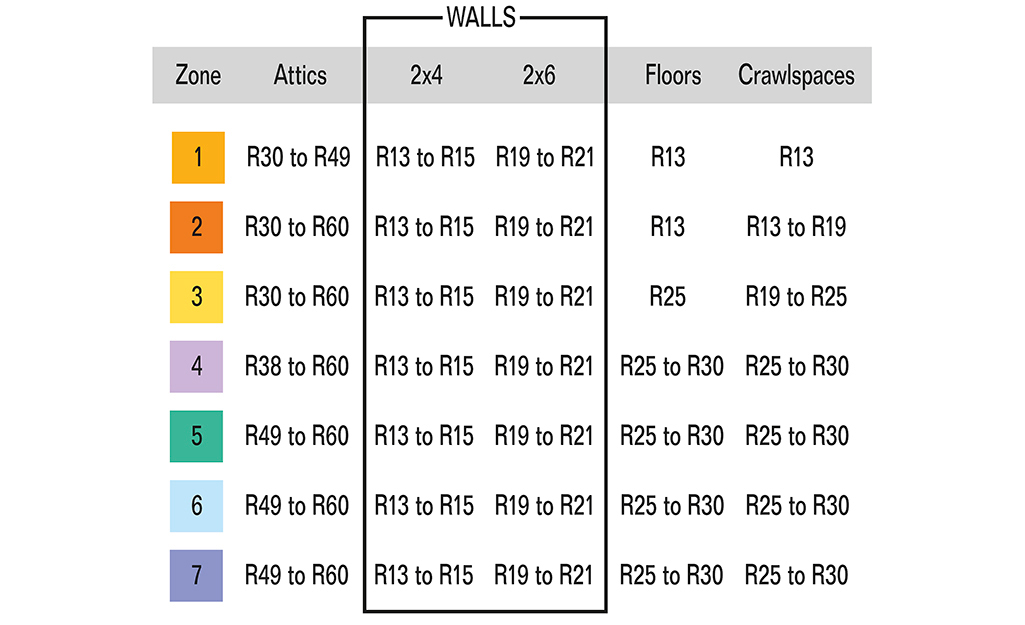
Find your zone on the map and then use the above insulation R-value chart to determine the level of insulation you need to properly insulate your attic, walls, floors and crawlspaces. These R-values are a sum, meaning this should be the total R-value once you add up the entire depth of insulation. For example, if you have a type of insulation that has an R-value of R-5 per inch of thickness, you will need a depth of 6-inches of this insulation installed in your attic to reach R-30 if you live in Zones 2 or 3.
The R-value of insulation can be affected by factors such as air leakage, moisture, and compression. Proper installation and maintenance are important to ensure that insulation maintains its R-value over time.
It’s important to choose insulation materials that are appropriate for the intended use and meet safety and environmental standards. Some materials may have higher R-values but may also pose health or safety risks, so it’s important to consider all factors when selecting insulation.