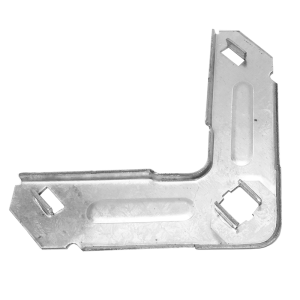
Wall thickness / gauge
2.0mm
Material
Q235B steel, SPHC steel or upon request
What it is
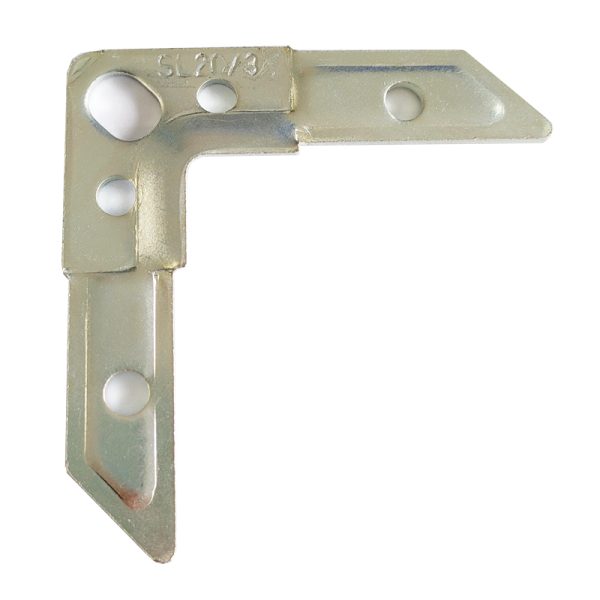
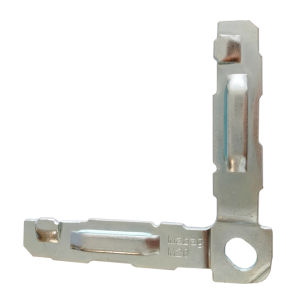
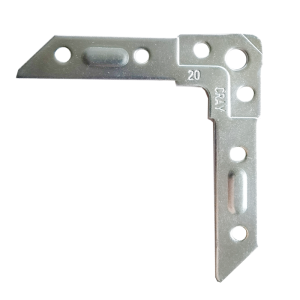
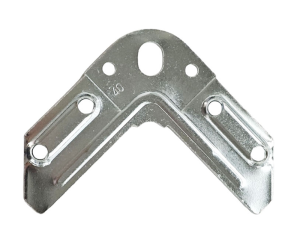
This unit is supplied as item code SL20/3, in Q235B steel, SPHC steel or upon request / 2.0mm, finished with zinc plating. A rectangular duct corner is the pressed connector that closes the four corners of a fabricated sheet metal duct. It is the part that decides whether your duct run is square, airtight and able to hold its shape under positive pressure. We press corners for the two common fabrication systems — TDF (T-shaped dry flange, around a 20 / 30 / 40 mm profile) and TDC / snap-lock (a nested profile that slots into the corner) — as well as the GC / R5-type corner clamps used to grip the seam on lock-former built duct.
The corner is formed in one operation from a flat blank, so there is no welded seam in the corner radius. That matters: a welded corner on a galvanized duct has to be ground back, the zinc is destroyed at the weld and the corner becomes the first place corrosion starts. A pressed corner keeps the coating continuous from the flat blank into the bend, which is why it is the standard detail on insulated and low-to-medium pressure ductwork.
Every corner in this range is supplied to the profile width and metal gauge you fabricate with. Match the three variables — profile width, material and thickness — and the corner drops into the existing workflow with no jig change. Galvanized steel is the default for dry indoor air handling; stainless 304 and 316 are used where the air is humid, salt-laden or chemically aggressive; aluminium is chosen when the duct has to be light for retrofit or shipped as spares.
Technical specification
| Item code | SL20/3 |
|---|
| Wall thickness / gauge | 2.0mm |
|---|
| Material | Q235B steel, SPHC steel or upon request |
|---|
| Finish | zinc plating |
|---|
| Notes | Corner for 20mm profile |
|---|
How to choose the right one
- Match the corner to your duct profile width first — 20 mm, 30 mm and 40 mm profile corners are not interchangeable. Ordering the profile width right is what makes the corner slide in without re-working the seam.
- Set the gauge to the pressure class. Low pressure supply and return ductwork (below approximately 750 Pa) works at 1.5–2.0 mm; anything that runs higher, or that sits on a long unsupported span, should be pushed to 2.3 mm and above.
- Pick the material from the air and the site. Galvanized Q235B or SPHC for ordinary commercial ductwork, SS304 for washrooms, kitchen extract, swimming pools and coastal plant rooms, SS316 where the air carries chemical or chloride-bearing air.
- Decide stackable or insertion. Stackable TDF / TDC corners let the installer pre-stack corners on the floor before lifting the panel; insertion corners are pushed into the profile from inside the duct.
- For lock-former produced duct, the GC / R5 corner clamp is the right part rather than a flange corner — it grips the locked seam from the outside and needs no separate flange angle.
Material and finish options
| Material | Finish | Typical use |
|---|
| Galvanized Q235B | Zinc plated | Dry indoor air handling, general commercial ductwork |
| Galvanized SPHC | Zinc plated | Deeper drawn sections, formed corners |
| Stainless steel 304 | Zinc-plated-equivalent / mill finish | Washrooms, kitchen extract, pool halls, coastal |
| Stainless steel 316 | Mill finish | Chemical plant, marine, wastewater air handling |
| Aluminium | Mill / natural | Retrofit, light-weight spares, clean room |
Installation
- 1
Bend and lock the first panel of the duct section, leaving the corner open on the side you are going to close.
- 2
Slide the pressed corner onto the two mating profile legs and check the corner is square with a set square before fixing — a corner out of square is much more expensive to correct once the section is assembled.
- 3
Fix with the method your fabrication standard uses: pop rivets for thin gauge, self-drilling screws for 2 mm and above, or TDF gasket and clamps for a sealed low-leakage joint.
- 4
Repeat for the four corners of the section, then check the diagonal measurements match before closing the top panel.
- 5
Where the duct is insulated, seal the corner after insulation with foil tape or mastic — the pressed profile itself is airtight, the insulation is what you must seal.
- 6
Pressure test the section before closing the ceiling void, and record the leakage figure; this is the point at which a badly fitted corner shows up as a real cost.
Where it is used
Office and retail towers
Vertical shafts and floor-by-floor horizontal runs; corners ordered by floor to keep spares to the profile actually used on site.
Hospitals and laboratories
SS304 corners on extract and dirty-air systems where the surface has to be cleanable and the corner must not become a corrosion source.
Food and beverage plant
Wash-down environments; stainless corners on product-adjacent extract runs.
Shipbuilding and marine HVAC
Salt-laden outside-air intakes and engine room extract; SS316 where chloride is present.
Data centres and clean rooms
Low-leakage square ductwork where the corner geometry is controlled to keep the airflow balanced.
Packaging, shipping and OEM
| Minimum order quantity | MOQ is normally 300–500 pcs per model for stock items and 500 pcs per model for made-to-order sizes |
|---|
| Lead time | 25-30 days for standard sizes after order confirmation; tooling for new tooling parts starts around 35 days |
|---|
| Samples | Sample pieces can be sent 3-5 days against your specification; courier cost is on the buyer side for the first trial order |
|---|
| Packing | Standard export packing: bulk in corrugated cartons with pallet on request; retail colour box and printed barcode available for OEM orders |
|---|
| OEM | OEM is available — item code, laser logo, carton print and retail box can all carry your brand |
|---|
| Trade terms | FOB Ningbo / Shanghai; T/T 30% deposit before production and 70% against copy of B/L |
|---|
Frequently asked questions
Which profile width do I need to match — 20 mm, 30 mm or 40 mm?
Take the measurement of the profile leg on your existing duct, not the duct size. A 400 x 400 duct built on a 20 mm profile needs CL20 / SL20/3; the same duct built on a 40 mm profile needs CL40. Mixing them means the corner sits proud and the panel will not close.
What thickness should I order for high pressure ductwork?
Standard corners run 1.5–2.0 mm for low pressure work. Move up to 2.3 mm, 2.5 mm or 3.0 mm — the GC and R5 clamps are supplied up to 3.0 mm — when the duct runs above roughly 750 Pa or when the section is large and needs corner stiffness.
Can I get 316 stainless with the same geometry?
Yes. 304 and 316 are formed from the same blank and take the same tooling, so the profile and the fixing holes stay the same. Only the material cost and the lead time change.
Is a pressed corner better than a welded corner?
For galvanized duct, yes — welding destroys the zinc layer in the corner radius and leaves you grinding and touching up on a part you cannot paint afterwards. A pressed corner keeps the coating continuous.
What is the difference between a stackable TDF corner and a TDC corner?
A stackable TDF corner nests onto the flat flange profile so installers can pre-assemble corners on the floor and carry them up to the ceiling as a stack. A TDC corner inserts into a snap-lock profile from inside the duct. Same job, different fabrication method.
Do you make non-standard profile widths?
Yes — send the profile drawing or a sample of the existing corner and we will quote the blank. New tooling starts before first production; existing profiles are usually a re-cut of the blank rather than new tooling.
What is the standard finish and how is it applied?
Zinc plating as standard, applied electrochemically over the formed part. For outdoor or high-humidity use, ask for the thicker zinc passivation or switch to stainless rather than relying on plating alone.
How are the corners packed for shipment?
Bulk in cartons so they can be stacked on site, or in individual polybags if the site is a clean environment. Retail boxes and printed cartons are available for OEM orders.
Related parts and capabilities
Not sure which variant fits? Send the drawing, the profile width or the outside diameter and we will confirm the part before you order. Email sales@climatecarer.com