Address
China-Base Plaza, No.666 Tiantong South Rd, Yinzhou Dist., Ningbo,Zhejiang, China, 315199
Work Hours
Monday to Friday: 9AM - 6PM
Weekend: 10AM - 5PM

Address
China-Base Plaza, No.666 Tiantong South Rd, Yinzhou Dist., Ningbo,Zhejiang, China, 315199
Work Hours
Monday to Friday: 9AM - 6PM
Weekend: 10AM - 5PM
Shipping routes between Asia and Europe remain under pressure as Middle East tensions, war-risk surcharges, and rising metal prices reshape global supply chains. Learn how these developments are affecting transit times, freight costs, and why importers are adjusting their purchasing strategies in 2026.
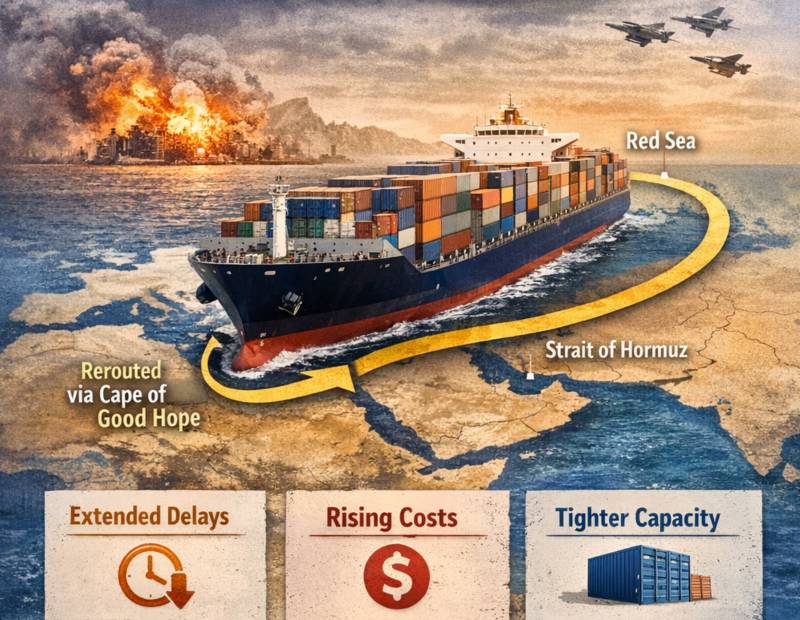
Global supply chains between Asia and Europe are facing several simultaneous challenges in 2026.
Shipping disruptions in the Middle East, longer maritime routes, rising freight surcharges, and increasing raw material prices are all contributing to higher uncertainty for importers.
For companies sourcing products from Asia, understanding these factors is essential for effective purchasing and inventory planning.
In this article, we will examine the key developments affecting supply chains and explain why many importers are starting to place orders earlier than usual.
Since late 2023, security risks in the Red Sea region have forced many shipping lines to avoid the traditional Suez Canal route.
Instead, vessels traveling from Asia to Europe are being rerouted around the Cape of Good Hope in southern Africa.
This detour significantly increases the distance traveled by cargo ships.
As a result, shipping transit times have already increased by approximately 10–15 days compared to normal schedules.
Recent geopolitical tensions in the Middle East have added further uncertainty, and additional operational disruptions such as:
are becoming increasingly common.
In some cases, shipments may face an additional 3–7 days of delay on top of the existing extended transit time.
In response to rising security risks in the region, shipping companies have introduced new war-risk surcharges.
These charges are applied in addition to the already elevated freight rates caused by the Red Sea disruption.
Some carriers have announced surcharges of approximately $1,500 per container, significantly increasing total transportation costs.
Because vessels are traveling longer distances and spending more time at sea, global shipping capacity is effectively reduced, which can further drive up freight rates and make container space harder to secure.
For importers relying on predictable delivery schedules, this situation creates new planning challenges.
Logistics is only part of the story.
Another important factor affecting supply chains in 2026 is the continued increase in raw material prices, particularly for metals such as aluminum and copper.
These materials are widely used in many of our products, including:
Since the beginning of the year, both aluminum and copper prices have shown a steady upward trend.
Before the Chinese New Year holidays, many manufacturers like us purchased some additional raw materials to ensure production continuity.
Because of this safety stock, we are still be able to produce current orders using earlier purchased materials, which allows them to temporarily maintain existing pricing.
However, once these raw material inventories are depleted, manufacturers will need to purchase new materials at higher market prices.
At that point, price adjustments may become unavoidable.
When several supply chain pressures occur simultaneously, companies often adjust their procurement strategies.
Currently, many of our customers and importors are facing:
Under these conditions, placing orders earlier can help mitigate several risks.
Earlier purchasing may allow companies to:
For businesses that rely on consistent supply from Asia, proactive planning can be an important competitive advantage.
Global supply chains rarely experience just one disruption at a time.
The current environment combines geopolitical risks, logistics disruptions, and raw material inflation, creating a more complex sourcing landscape for importers.
Companies that monitor these developments and adjust their procurement timelines accordingly are often better positioned to manage cost fluctuations and delivery uncertainty.
Planning orders earlier and maintaining clear communication with suppliers can help businesses navigate these challenges more effectively.
If your company imports products from Asia and is reviewing sourcing plans for the coming months, it may be beneficial to evaluate lead times and production schedules in advance.
Freight and raw material move on the same clock, and for an importer that means the order decision and the shipping decision are no longer separate. A production slot held waiting on a booking is the same cost as a ship waiting on cargo; the difference is only who is paying for it. Confirming the shipment window at the time of the order is the cheapest way to avoid both.
The useful response to a disruption is narrowing what you hold, not widening it. Keep the fast-moving item codes where demand is proven and steady, and leave the long tail to be ordered against a project. On our side we quote the goods and the freight together where we can, so the landed number you decide on is the number the shipment actually costs.
{"@context": "https://schema.org", "@type": "FAQPage", "mainEntity": [{"@type": "Question", "name": "Does a freight delay change what I should order?", "acceptedAnswer": {"@type": "Answer", "text": "It changes the order quantity and the timing, not the specification. What it does change is the value of confirming the shipping window early, so a production slot is not held waiting on a booking."}}, {"@type": "Question", "name": "Should I hold more stock because of the disruption?", "acceptedAnswer": {"@type": "Answer", "text": "Only the fast-moving item codes, and only where the market already tells you demand is steady. Holding a full catalogue against a freight risk costs more than the freight."}}, {"@type": "Question", "name": "What information do you need from me to quote shipping?", "acceptedAnswer": {"@type": "Answer", "text": "Destination port or airport, the carton count and the gross weight, and whether you want a consolidated or an exclusive shipment. With those we can quote the freight alongside the goods rather than as a surprise later."}}]}
If you would like to discuss production lead times, shipping options, or current material trends, feel free to contact us. We are always happy to share insights and support your sourcing needs. Let's Talk!