Address
China-Base Plaza, No.666 Tiantong South Rd, Yinzhou Dist., Ningbo,Zhejiang, China, 315199
Work Hours
Monday to Friday: 9AM - 6PM
Weekend: 10AM - 5PM

Address
China-Base Plaza, No.666 Tiantong South Rd, Yinzhou Dist., Ningbo,Zhejiang, China, 315199
Work Hours
Monday to Friday: 9AM - 6PM
Weekend: 10AM - 5PM
Learn how old tires get a second life as rubber foot for outdoor air conditioners and heat pumps. These fix it rubber feet reduce vibration, lower noise, and deliver reliable performance outdoors.
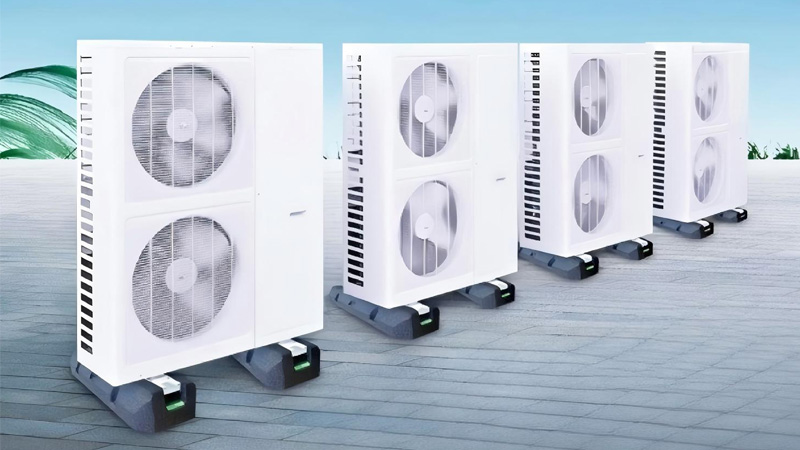
If you’ve ever taken a close look at your outdoor air conditioning or heat pump unit, you’ve almost certainly seen therubber feet underneath. They’re easy to overlook — just 2pcs/set or 4pcs/set solid blocks sitting under your mini split outdoor units. However, without them, all the vibration from the compressor would travel straight into your walls or mounting structure, turning that quiet AC hum into something that shakes the whole room.
And here’s something you might not know: those heavy‑duty rubber feet are often made from recycled car tires.
As we all know, millions of tires retire and reach the end of their lifespan every year. Treads wear thin, sidewalls crack, and they get replaced with new ones. Then the big question becomes: what we can do with all those old tires?
For a long time, the answer wasn’t good enough.
Tires pile up in landfills, where they barely break down at all — rubber is incredibly durable, and it can sit there for decades. Some end up in illegal dumps. Others get burned, releasing heavy smoke and harmful chemicals into the air. It’s a real problem that needed good solutions. And as it turns out, one of those solutions is sitting right under your outdoor AC or heat pump.
Turning a worn‑out tire into a heavy‑duty, precision‑cut rubber foot isn’t magic, but it does involve a careful production process.
It starts with sorting. Car tires have softer rubber, which works really well for absorbing vibration. Truck tires are tougher and denser — still usable, just different. Workers cut out the thickest parts of the sidewall, which is the best material: flexible, elastic, and less worn down from the road.
Then the tires go into a shredder. Big chunks come out. After several rounds of grinding, those chunks turn into small granules — kind of like coarse sand, but black and bouncy.
But tires aren’t just rubber. They have steel belts inside and nylon fibers woven throughout. Both have to be removed. Magnets pull out the steel. Air blowers separate the lightweight fibers. What’s left is clean, pure rubber granules, ready for the next step.
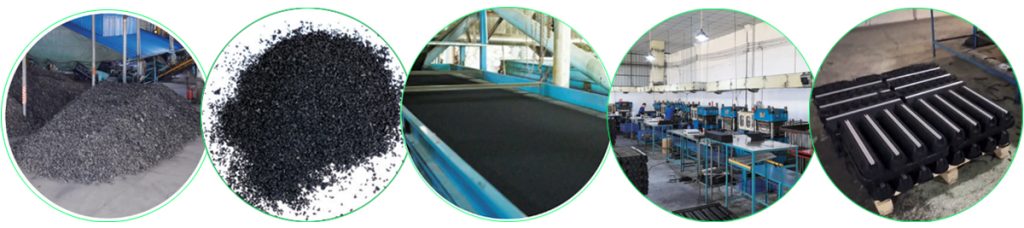
Here’s the thing: those little granules don’t stick together on their own. They’re just tiny pieces of old tire.
To turn them into a solid, load‑bearing rubber foot, you need a binder. A polyurethane adhesive is mixed in — just the right amount to coat every granule. Too little, and the foot will fall apart. Too much, and it becomes hard like plastic, losing its ability to absorb vibration.
The coated granules go into a mold shaped like an AC or heat pump rubber feet. Then a hydraulic press comes down — hard. We’re talking about the weight of a small car, pressed into an area the size of your palm. The pressure squeezes everything tight while the adhesive cures, locking the granules into a strong, solid block.
After setting and fully hardening, the feet are removed from the molds. Workers trim off any extra edges, and they’re ready to be shipped.
Good question. Old tires have already lived one life. Can they really handle a second one, supporting a heavy, vibrating outdoor unit year after year?
The short answer: yes — within reason.
Tire rubber is built to absorb shock out on the road—and that same quality makes it perfect for damping vibration from air conditioner and heat pump compressors. Of course, no recycled material lasts forever. Prolonged exposure to sunlight and extreme temperatures can make rubber harden or crack over time. That’s why these damping feet, just like tires, will eventually need replacing. But here’s the key point: our rubber feet are produced with anti-UV addictive ingredient that supports long, reliable service.
We didn’t just take that for granted—we had our product tested in a lab.
The lab ran a UV aging test using UVA-340 fluorescent lamps at 0.76 W/m², targeting the most harmful short-wave UV rays from sunlight. The test cycle was set to 8 hours of light at 60°C, followed by 4 hours of condensation at 50°C, mimicking day-night cycles and dew formation. After 72 straight hours of testing—equal to months of outdoor exposure—here’s what the report found:
| Test Item | UV Aging Test |
|---|---|
| Sample | Rubber damping base of air conditioner (1 pc) |
| Lamp Type | UVA-340 |
| Irradiance | 0.76 W/m² |
| Cycle | 8h light @ 60°C / 4h condensation @ 50°C |
| Duration | 72 hours |
| Equipment | UV aging tester (AGC-RE-E151, calibrated 2020.06.16) |
| Result | After the test, the appearance of the sample was slightly yellow and there was no appearance damage. |
Let’s make it simply to understand: only minor discoloration, with no cracking, chalking, or deformation at all.
That tells us the UV-resistant additives we use are doing exactly what they’re supposed to. Recycled rubber won’t last a lifetime, but with the right formula, it can do its job reliably for its entire designed service life.
My favorite part? When those fix-it rubber feet finally wear out, they don’t have to become waste again.
They can go back through the grinder, get mixed with fresh adhesive, and become something new — maybe a playground surface, a floor mat, or even another set of rubber feet for someone else’s outdoor unit.
The old tire on your car today could end up supporting your AC or heat pump tomorrow. And when that unit is replaced, its rubber feet could live on in something else entirely.
Not a bad second life for something that started as a lump of crude oil, became a tire, rolled thousands of miles, and didn’t end up in a dump — but instead quietly does its job, keeping your home steady and quiet. We can offer fix it foot 250 and fix it foot 600 and fix it foot 1000 ect. If you want to learn more about our rubber feet, please feel free to contact us!