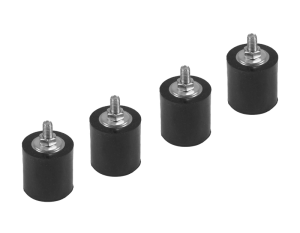
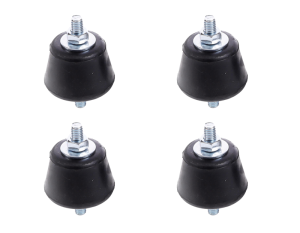
What it is
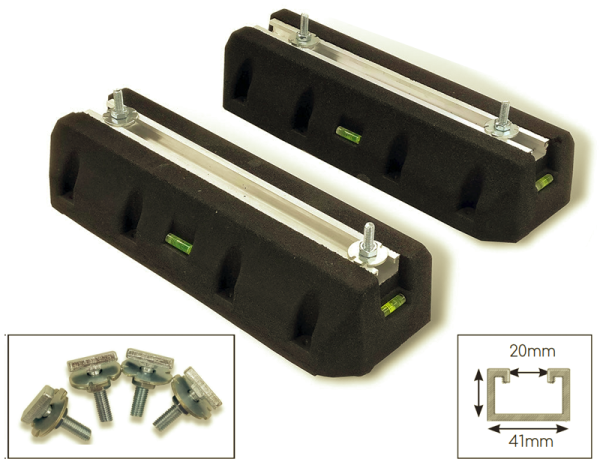
This unit is supplied as item code RF. An anti-vibration mount is the interface between a vibrating machine and the building that carries it. It does two jobs at once: it carries the static weight of the machine, and it decouples the frequency of the machine from the natural frequency of the supporting structure. Get that first one wrong and the mount compresses over time and the machine ends up out of alignment; get the second one wrong and the vibration that was supposed to be isolated travels straight into the slab and into the rooms above.
The mounts in this range are moulded natural rubber bonded to a galvanized stud and nut, supplied as a set. Natural rubber is used rather than a synthetic compound because it has the elastic range needed for genuine isolation and behaves predictably under sustained compression; the Shore hardness of the rubber is what sets both the load capacity and the isolation frequency, and it is offered in several hardnesses so one family can cover a range of machine weights.
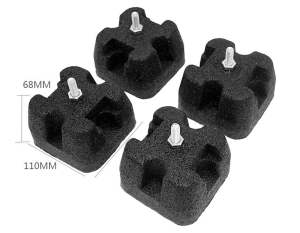
Supports for outdoor condenser and heat pump units are a separate and more demanding detail: the mount has to hold the machine level on an external base, carry wind and seismic load, and survive years of weather. That is why the outdoor family is specified by load rating rather than by hardness alone.
Technical specification
How to choose the right one
- Work out the static load per mount first — machine weight divided by the number of mount positions. That number, not the machine nameplate, is what selects the mount.
- Pick the Shore hardness from the load. Softer rubber carries less load and gives more isolation; harder rubber carries more and transmits more. Each product lists the hardnesses available so you can match the loading.
- Calculate the isolation frequency against the machine running speed. A mount that is too stiff for the machine speed will not isolate at all, however good the rubber is.
- For outdoor units, choose by load rating and check the mount holds the unit level on the base; a mount that rocks under wind load is a noise and a warranty problem, not just a comfort problem.
- Check the environment. Natural rubber is fine for the large majority of HVAC and compressor applications; in mineral-oil contact or in strong solvents, the compound needs to be specified separately.
Material and finish options
| Material | Finish | Typical use |
|---|
| Natural rubber, galvanized steel stud and nut | Zinc plated steel | General HVAC and compressor isolation |
| Natural rubber, hardness 30 Shore | Zinc plated steel | Lower load, higher isolation |
| Natural rubber, hardness 45 Shore | Zinc plated steel | Mid-range machine loads |
| Natural rubber, hardness 65 Shore | Zinc plated steel | Higher load, limited isolation needed |
| Stainless stud on request | Mill finish | Coastal and wash-down plant |
Installation
- 1
Set the machine on a level base first — a mount fitted to an out-of-level frame is carrying load on one corner from day one.
- 2
Fit the stud through the machine fixing hole with the nut on the far side, or into the base tapping, and do not over-tighten: over-tensioning the stud compresses the rubber beyond its designed deflection.
- 3
Leave the same gap all round each mount so the rubber has room to deflect; a mount against a stop cannot isolate.
- 4
Check the level of the machine after the mount has taken load, then re-check after the first running week.
- 5
On outdoor plant, check the mounts and the fixing bolts each season — weather and vibration work the galvanized stud loose faster than it looks from the factory.
- 6
Do not stack a second mount on top of the first to get more height; use the height of the mounting plate instead.
Where it is used
Commercial HVAC
Air handling units, fan coil units, roof-top units.
Heat pumps and mini split
Outdoor unit feet and ground supports for condenser placement.
Compressors and pumps
Chiller and pump pad isolation.
Industrial
Presses, production equipment, ventilation sets.
Marine and rail
Vibration isolation on vibration-carrying structures.
Packaging, shipping and OEM
| Minimum order quantity | MOQ is normally 300–500 pcs per model for stock items and 500 pcs per model for made-to-order sizes |
|---|
| Lead time | 25-30 days for standard sizes after order confirmation; tooling for new tooling parts starts around 35 days |
|---|
| Samples | Sample pieces can be sent 3-5 days against your specification; courier cost is on the buyer side for the first trial order |
|---|
| Packing | Standard export packing: bulk in corrugated cartons with pallet on request; retail colour box and printed barcode available for OEM orders |
|---|
| OEM | OEM is available — item code, laser logo, carton print and retail box can all carry your brand |
|---|
| Trade terms | FOB Ningbo / Shanghai; T/T 30% deposit before production and 70% against copy of B/L |
|---|
Frequently asked questions
How do I size a mount to my machine?
Divide the machine weight by the number of mounting points to get the load per mount, then choose the hardness and the load range that covers it. Send the weight, the number of mounts, the machine speed and any vibration frequency you have measured and we will confirm the selection.
Which Shore hardness should I use?
The hardness sets the load capacity and the isolation frequency together. Lighter machines take a softer compound, heavier machines take a harder one, and the deciding number is usually the isolation frequency you need against the running speed. This is why the range is offered in several hardnesses.
Is this natural rubber or EPDM?
Natural rubber, moulded and vulcanised. That matters if your specification names the compound — natural rubber is the standard for HVAC isolation mounts, while EPDM is specified for weather and ozone resistance and oil compatibility is a different question again.
Can mounts be used outdoors?
Yes for the outdoor-family supports rated for it, which are selected by load rating rather than hardness. For long-term external exposure on a coastal site, ask about the stainless stud option.
Do you make custom load ratings?
Yes — send the load, the bowl or housing dimension and the stud position, and we will confirm a moulding or quote new tooling.
How many pieces per set?
Sets are supplied as four-piece assemblies for the standard square arrangement; other quantities are available for shapes that need more positions.
Related parts and capabilities
Not sure which variant fits? Send the drawing, the profile width or the outside diameter and we will confirm the part before you order. Email sales@climatecarer.com